Wildfire-WhispersHow do humans coexist with extreme weather?
A 3m×2m geometric installation paired with a satellite-data poster series. Real-time gesture recognition turns five years of wildfire records into something a body can feel.
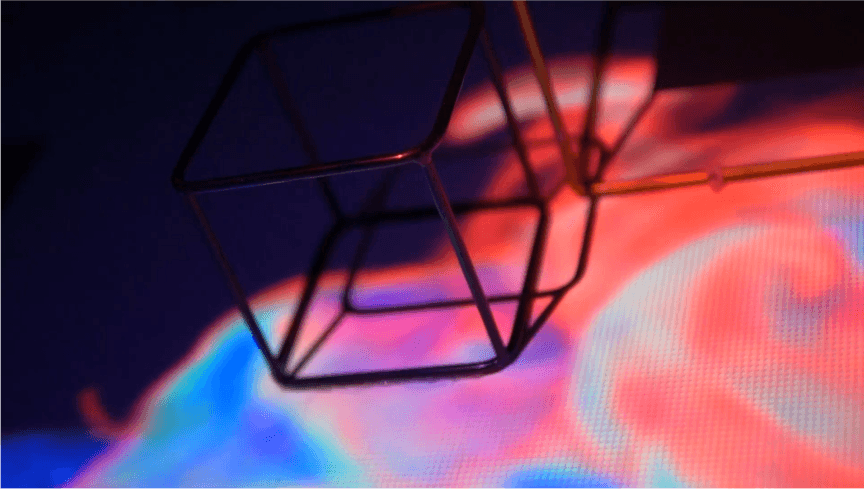
An immersive installation that turns five years of satellite wildfire data into something a body can feel. Gesture-driven projections plus a starburst-tree poster series invite a visitor to encounter climate intensity as a sensory event, not a chart.
The Challenge
Wildfire awareness usually arrives as bar charts and dashboards — and gets scrolled past. As an undergraduate designer interested in how environmental data changes behaviour, the design question became: can the same data be felt rather than read, without trivialising the disaster, and without losing data integrity?
Research & Discovery
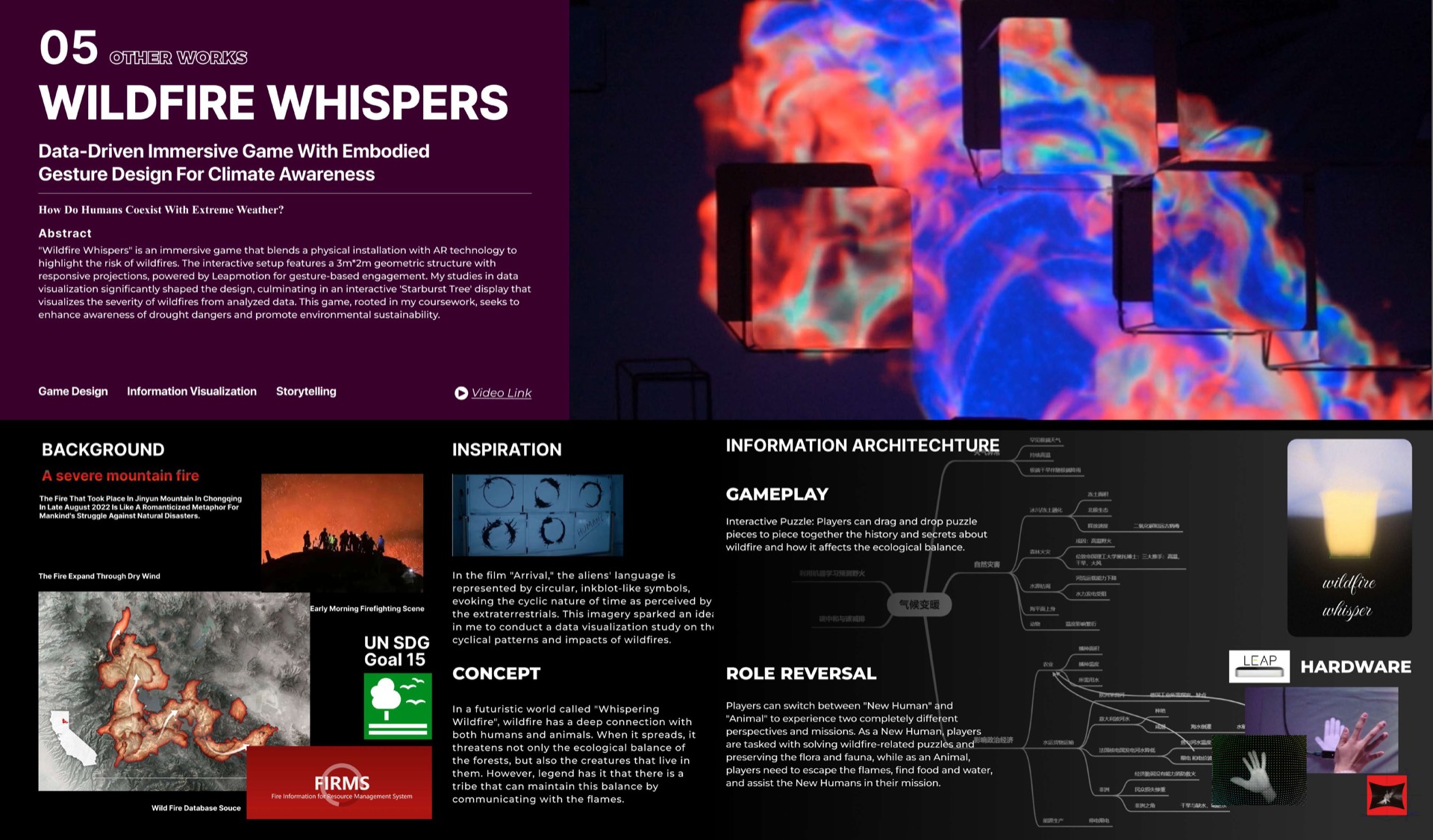
Inspiration drawn from Arrival — the alien language as circular, ink-blot symbols evoking the cyclic nature of time. That visual primitive translated cleanly to wildfire data: each fire has a start, an expansion arc, and a fade.
Source data: global satellite wildfire records, 2017–2021 (FIRMS). The work uses both the data itself and a fictional frame ('In a futuristic world called Whispering Wildfire, wildfire has a deep connection with both humans and animals…') drawn through the project, mapped to UN SDG Goal 15 (Life on Land).
Design Strategy
Three design commitments:
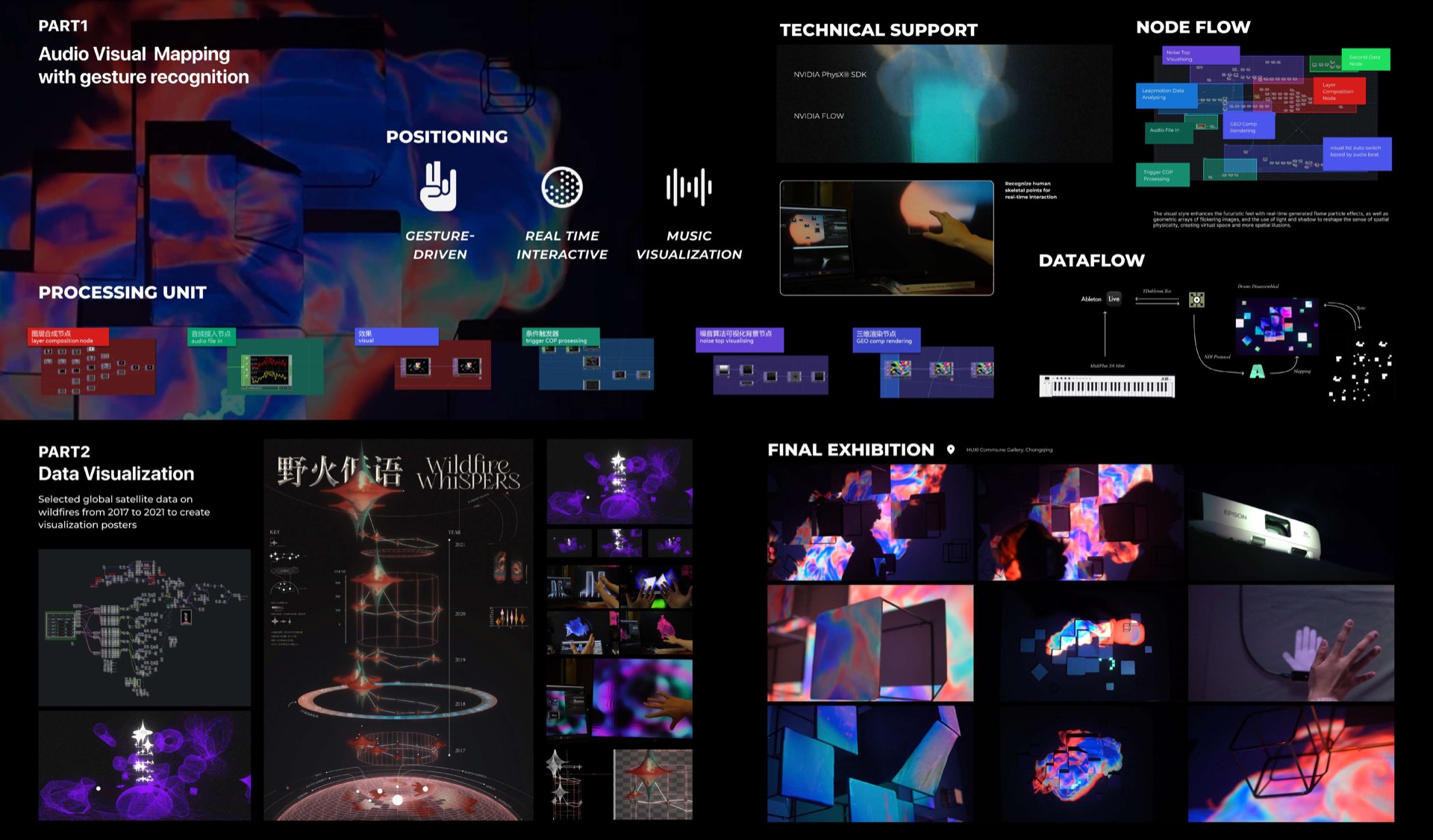
- Two parts, one logic. Part 1 — a real-time installation with audio-visual mapping driven by gesture recognition. Part 2 — a data-visualisation poster series turning satellite wildfire data into 'starburst tree' compositions.
- Body-first input. Leap Motion plus Unreal Engine for gesture-driven interaction; the visitor's hand becomes the cursor onto the data.
- Role reversal as game design. In the interactive puzzle layer, players switch between 'New Human' and 'Animal' to experience two perspectives — as a New Human, you solve wildfire-related puzzles and protect the flora and fauna; as an Animal, you escape the flames and find food.
Implementation & Pipeline
Hardware: a 3m × 2m geometric wall-mounted setup with responsive projections. Leap Motion sensor for gesture recognition. NVIDIA PhysX SDK + NVIDIA FLOW + a custom node-flow / dataflow pipeline.
Software: real-time gesture-driven particle effects and parametric arrays of flowing, leaf-like shapes; the visitor's hand sets a sense of spatial physicality and energetic flow. Music visualisation as a secondary input.
Visualisation series: selected global satellite data (2017–2021) → starburst-tree posters where fire severity drives the visual cadence.
Results & Impact
Two design outputs:
- An immersive embodied installation translating wildfire intensity into gesture-driven audio-visual response.
- A data-visualisation poster series that holds up to scrutiny as both data work and as design objects.
Final exhibition at H.U.B Cherrytree Gallery, Chongqing.
Lessons Learned
Two carry-forwards:
- Embodied data is design, not data. The same dataset earns a thousand different feelings depending on what the body does to interact with it. The design contribution sits in the gesture-to-mapping function, not in the dataset.
- Speculative fiction earns the data its weight. Without the 'Whispering Wildfire' framing, the visualisations are pretty; with it, they have a story to live in.
What's Next
The pattern — pair satellite environmental data with a body-first input layer — is portable to deforestation, glacial retreat, ocean acidification. Each one needs its own gestural vocabulary, but the underlying technique transfers.